Your Next Website Visitor Might Not Be a Person
More and more of the web is being read by AI agents acting on someone’s behalf, not by people. They don’t browse like we do, and most sites aren’t built for them yet. Here’s why agent-readiness matters and what we do about it.
For about thirty years, web design has had one audience in mind: a person. Someone with eyes, a screen, and a cursor or a thumb. We arrange things so they can scan a page, find the button, and understand what a business does. Almost every instinct we have about building a good website is really an instinct about being legible to a human being.
That assumption is quietly breaking. A growing share of the visits to any given site now come from AI agents, software acting on a person's behalf. Someone asks their assistant to find a supplier, book a service, compare two products, or dig out a returns policy, and the assistant goes off and reads the web to answer. The human never sees the page. The agent does.
Agents Don't Browse Like We Do
Here's the thing that catches a lot of sites out: an agent doesn't experience a website the way a person does. It doesn't admire your hero image or feel reassured by your photography. It's looking for structure and signals, machine-readable clues about what a site is, what it offers, and how to interact with it.
When those signals are present, an agent can act with confidence: it knows what you sell, where the contact route is, what your policies say. When they're missing, it does the worst possible thing, it guesses. And a confident guess that's wrong is far more damaging than an honest "I don't know." An agent that misreads your pricing, invents a policy, or simply can't tell what you do will quietly steer its user somewhere clearer.
A page can be beautifully designed, fast, and perfectly clear to a human, and still be close to opaque to the software now reading it on a customer's behalf.
Discoverable and Usable
There are really two questions here, and they're different.
The first is discoverability: can an agent find the right information at all? Can it reliably locate what you offer, how to get in touch, and the facts that matter, without scraping, guessing, or hallucinating?
The second, and the one most people overlook, is usability: once an agent has found you, can it actually act? Can it complete the task its user asked for, get a quote, start a booking, answer a question accurately, rather than just locate a page and stall?
Being agent-ready means saying yes to both. It's the same shift we went through with mobile and with accessibility: a new kind of visitor arrives, the old assumptions stop holding, and the sites that adapt early end up with a real advantage.
What We Do About It
We've started treating agent-readiness as a normal part of looking after a website, not an afterthought. That means looking at every client site through the agent's eyes as well as the visitor's: checking the signals software relies on, finding the gaps where an agent would be left guessing, and closing them in a sensible order.
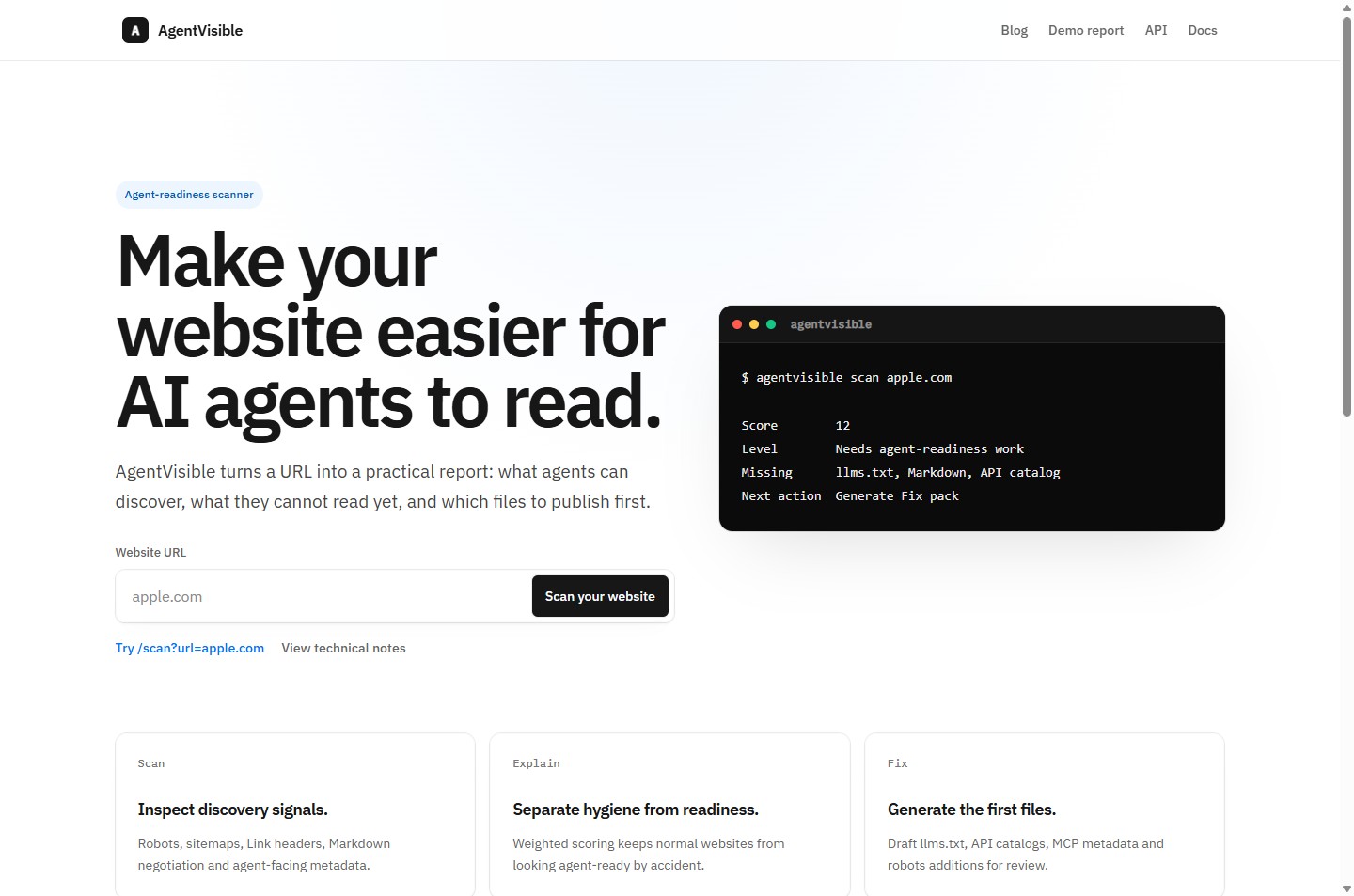
To make that something we can actually measure rather than hand-wave about, we built AgentVisible, a tool that scans a site and reports exactly how it looks to an agent: what's already there, what's missing, and what to fix first. It's free to try on any public site.
None of this is about chasing a trend. It's about a simple, practical bet: the way people reach websites is shifting from typing and clicking towards asking an assistant to do it for them. When that assistant arrives at your site, it should be able to find its way around and get the job done. Making sure of that, for every site we look after, is fast becoming as important as making the site work beautifully for the people behind those assistants.
Pixelshed
Building websites, internal tools, dashboards and automations for small teams.